Showing posts with label running the farm. Show all posts

April 30, 2013

Rainy days and Mondays

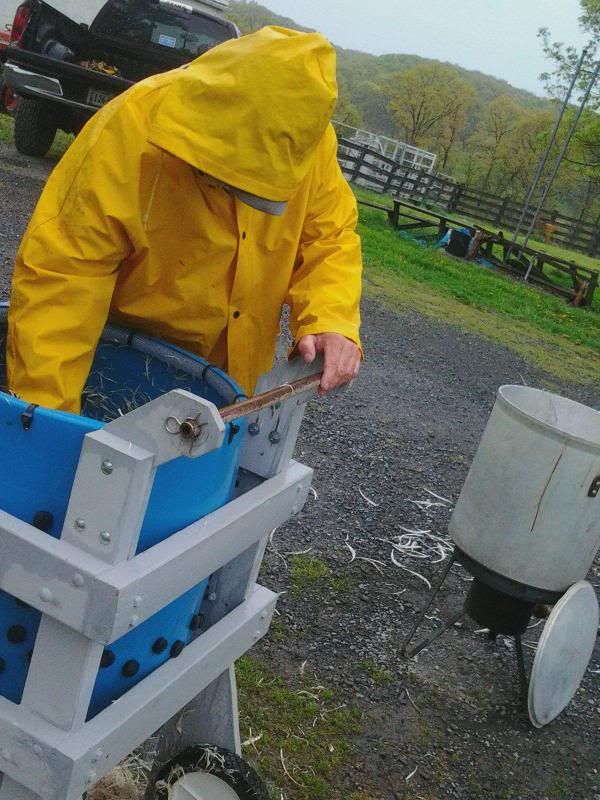
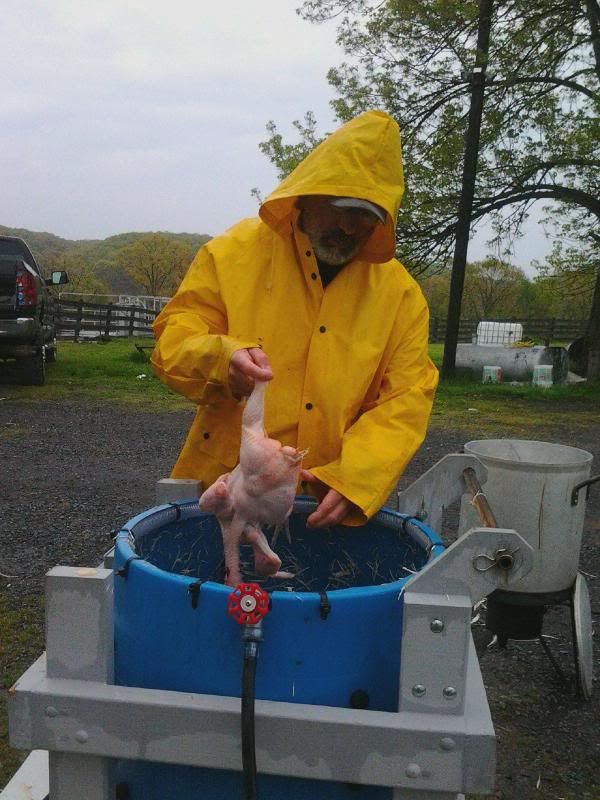
Chicken processing started on Sunday and continued into Monday.  Sunday was cold, wet and raw. Monday was no better. At times, it poured down the rain.


Chickens are dunked in the scalder to make plucking easier


Into the Whizbang Plucker Greg made


99% plucked chicken emerges

April 22, 2013

This is not the grocery store

"You mean I can come to your farm... and BUY meat? From you???"

Yes! You do not have to purchase your foods in a grocery store. And you are not limited to what is available at the local farmer's market (although farmer's markets are wonderful places to purchase locally produced food!).  You can find a farmer through a website like Local Harvest and Buy Fresh Buy Local, make an appointment to visit them, ask all about the products you're purchasing and even see where it is grown.

For some people, this is a completely foreign concept. For them, it is incomprehensible that the grocery store is unnecessary.

But it is completely irrelevant if you want to purchase local produce, herbs, meats, breads and dairy products.  As long as you are willing to do the research and spend a little time hunting out your sources, you can say good bye to most products purchased at a grocery store and get them from a local farmer or producer.

What to Expect
  • Expect to make an appointment and keep it.  Farms are busy places. Many farmers work full or part time jobs along with farming so always keep your appointment or call to let them know if you can't.
  • Expect to have your questions answered. Ask anything! It's the only way you'll know if the product is something you truly want to purchase. And farmers take pride in their work and love to talk about their farms.
  • Expect your purchases to cost more than grocery store products.  This is probably the most under-anticipated expectation for consumers when purchasing direct from a farm. There are a thousand reasons as to why the product costs more. A few - the cost of feed for the animals, time and labor, fresh, (usually) untreated products that are not picked before they are ripe and then artificially ripened with chemicals, processing costs for meat products that require USDA inspection, farm mortgage, equipment costs, organic certification costs.... Farmers shoulder a lot of up-front costs. 
  • Expect to purchase a higher quality product than what you will find in a grocery store. If it's not superior to the grocery store, say something! Let the farmer know! He'll either huff and puff or he'll take the constructive criticism under advisement and try to do better.
  • Expect a glimpse into what real, small family farming - not factory farming - is all about.


 We are not a grocery store. We're just a small farm, working hard to provide good quality products. Greg spent most of last week hand butchering and processing Cornish hens. In the end, we had birds that could sit on any grocery store shelf and compete with Tyson, Perdue and the others. But wow! What a difference in the quality and care that went into those birds from the day they hatched until we shut the freezer door on them.

Go find a farmer. Talk to them. Buy from them. Let them share their passion with you.

March 25, 2013

Training cattle

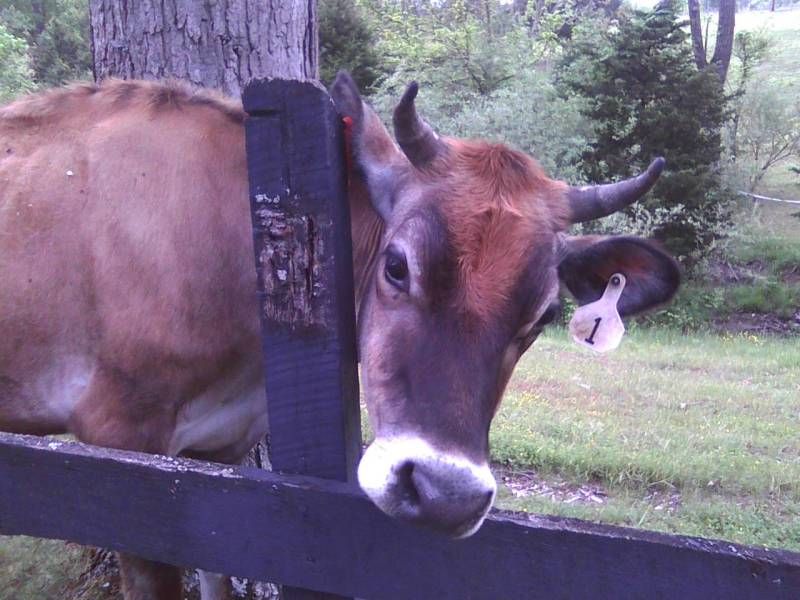
A few weeks ago, ten pregnant cows were brought to the farm. Since they arrived, one has delivered a beautiful bull calf and we're waiting for the rest to calve.

One of our first priorities was to train the cattle and to gain their trust.  Yes, you can train cattle. They must come when we call them.  We must have that control over them;  not just for rotational grazing but also for their own safety.  It is an imperative that they answer when we call them.

We also need them to trust us and not run away from us.  With cows ready to give birth, if something goes wrong, we need to know that our presence will not add more stress to the cow in an already stressful situation. The last thing we need is a cow fighting us when we're trying to help her push out a calf.

Just like with most animals, food is the great motivator.  We raise and finish our cattle on pasture, but in order to train these cows and to get them used to our presence, we call them up to the barn once or twice a day with the lure of sweet feed laced with mineral supplements from time to time.

So. How do you call cattle? Any call will work as long as you're consistent, but we shout out, "WHIRRRRLLLLLL"


December 20, 2012

Hello, Mr. Fox

Anytime you have livestock, predators will appear.  Cattle and pigs are not immune although we've not had any predation problems with those animals.  Our biggest issue has been loss of poultry and the fear of losing our rabbits.

We have a fox problem. The various trail cameras pick up foxes from time to time but the biggest indicator that a fox is nearby is the pile of feathers we find in a pasture.  This past week was been the second worst fox attack we've experienced. 

In the summer of 2011, we purchased over 40 laying hens.  In less than six weeks, we lost all but about a dozen of them.  It was devastating and heartbreaking. Fox got past the electric fencing and had a grand time.  It was a huge financial loss.  We had plans to grow our egg sales and use that as a way to attract customers to our other products.  In the end, we locked the remaining pullets in the coop with our first flock, let them get used to their new roosting location, then turned them loose in the yard.

We never expanded the flock again after that.  Eggs weren't selling and weren't profitable for us; there was no point to add more laying hens to the farm and increase egg production.  As time has passed, we've lost a chicken here and there. We had hens go broody and hatch chicks and we've incubated a few eggs as well.  Our modest little flock grew slightly.

Last week, we noticed that some of the chickens were missing.  Then we realized a few more were missing and we started adding it up. We had two beautiful young cockerels we hatched out earlier in the year. Two young pullets were also missing - one of which had just laid her first egg.  Rockstar, a large cantankerous Buff Orpington rooster, was also nowhere to be found.  And it seemed that our flock of hens was a bit smaller as well.  While moving cattle from one pasture to another, I came across piles of feathers. Yep. Fox attack. There weren't enough feathers to account for all the missing chickens but I could identify some of them by the feather piles.  As I herded the cattle past the pond, I came across two piles of duck feathers. This fox was bold and hungry.

Now the flock is locked in the coop again for their safety until this fox family moves on.  We heard them hunting one night.  The yip-howl they used to communicate as they hunted was eerie and somewhat scary.  I was very glad the chickens were safe in the coop that night.  So far, the rabbits have not had a problem with fox attack although I did find fox scat by one of the rabbit pens.

Predation is part of farming. You expect losses due to illness or complications during/after birth.  But when you lose animals to a  wild predator, it's almost an insult and always seems to hit you like a kick in the pants.  Being smart about preventative measures is your best defense. One day, I'd like to have a livestock guardian dog, especially now that the rabbitry is expanding.

Here's hoping this fox's days are numbered.

May 14, 2012

The Chicken Trail

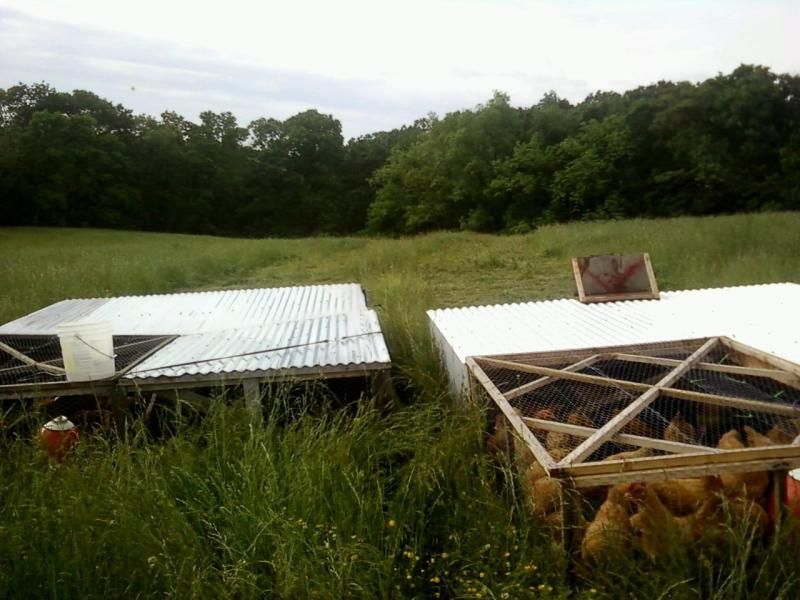
The trail behind the chicken pens shows where they have been on the pasture for the past week or so.

This is the best pasture on the farm right now.  Last year, the cattle fertilized it really well. Then we put the broiler pasture pens out there to add more nitrogen to the soil.  Then it rested.  No cattle grazed on it. No chicken pens. Some of the layer flock ventured out onto it from time to time but not very far out into the grass.  A few geese wandered over it earlier this spring. But we let time and the seasons work on all the nutrient rich fertilizer the animals left for the earth.  The result: the grass on this pasture came back the fastest of all the pastures this spring. It's thick, it's lush, it's fast growing.

By raising our chickens on pasture, we're helping to restore sustainability to the pastures on this farm.  Pasture raised chickens are a much superior consumer product that grocery store chicken. That's a proven fact. Not only are they good for your health but they help restore the health of the soil.  This beautiful pasture will now feed the cattle, helping them gain weight so that we can provide another healthy food product for our family and our customers - grass-fed and finished beef.

Each animal is doing their part to feed the pastures creating better quality grass for grazing and then better quality livestock.  It's an amazing circle of sustainability.

May 2, 2012

Mob grazing

We haven't posted much about cattle because there's not much to say. They are slow growing and have a long gestational period. They eat grass and hay. They moo. They walk around. Not very exciting. Not a lot to report on them unless something major happens such as new bottle-fed calves arriving or a sick animal.

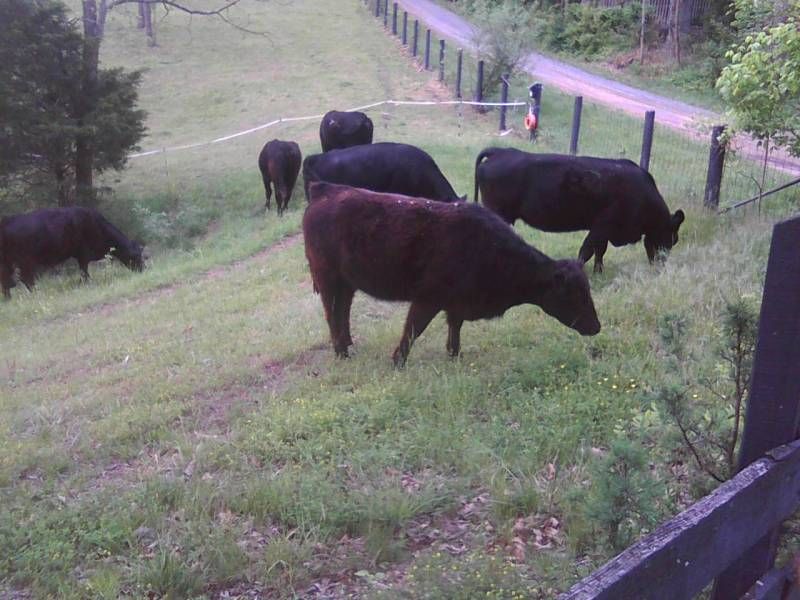
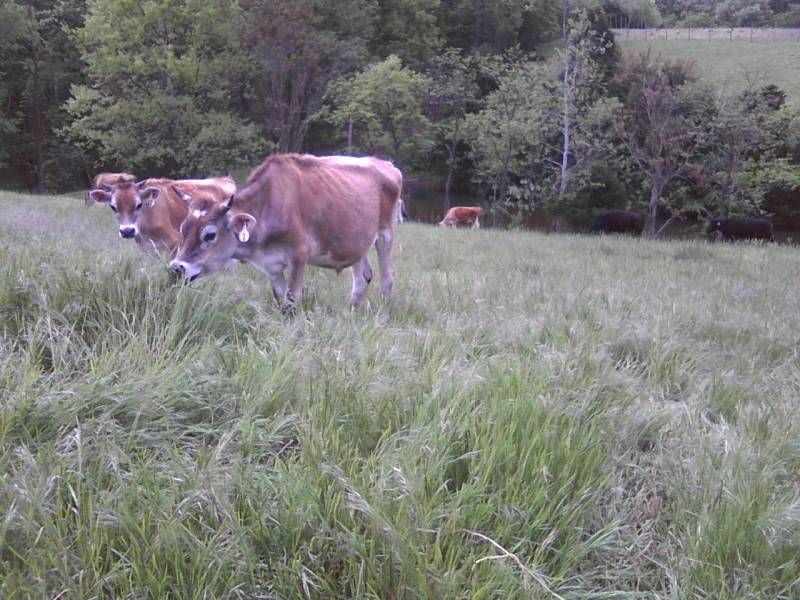
Right now, there are Jersey steers and dry Angus cows in the field.  The steers arrived here as bottle-fed calves in the winter of 2010/2011.  They are not growing quickly and Greg really wants to get some weight on them so they can be butchered this fall.

To that end, Greg has decided to take a new approach to managing the cattle during the spring and summer this year.  Typically, the cattle will graze on a very large pasture area for a long period of time, often for the entire season.  The cattle wear down that pasture and eat it down to the dirt.  It requires them to range over a large area, expending food energy that could be used to increase muscle mass and bring them to market weight much faster.

In comes the idea of "mob grazing".  This is also referred to as intensive pasture management.  I'm sure there are a few other catch phrase names for it, but we call it mob grazing.

The premise is simple. Reduce the amount of pasture the herd has access to, then move them to a fresh area as soon as they've eaten down one section.  Depending on the number of cattle in your herd and the size of the pasture area they are grazing, you might move them daily, every few days or weekly.  Your goals are: reduce the amount of walking, let the cattle eat down that area and let it rest and regrow before bringing them back to it, intense manure spread in a short period of time.

By utilizing this method of grazing, you are going to have more intense manure coverage in your pastures.  The cattle won't be walking over acres and acres and acres to find fresh growth of grass.  This will help them put on weight much faster.

Greg started this probably about a week ago. We've seen the cattle resting more - a sign that they are full and chewing their cud - instead of constantly wandering looking for new grass.  He hasn't had to put out any more hay.  They are getting fresh, tender, Spring grass.

Today, the cattle moved to a new section of pasture.  Only had to call them two or three times because once they realized it was time to move to new grass, they came running!

"Heads down" is a good sign during mob grazing. Everyone's eating and happy.

These are very slow growing dairy steers.  They are boney! We're hoping the mob grazing will put some significant weight on them.

April 6, 2012

Bunnies and chicks

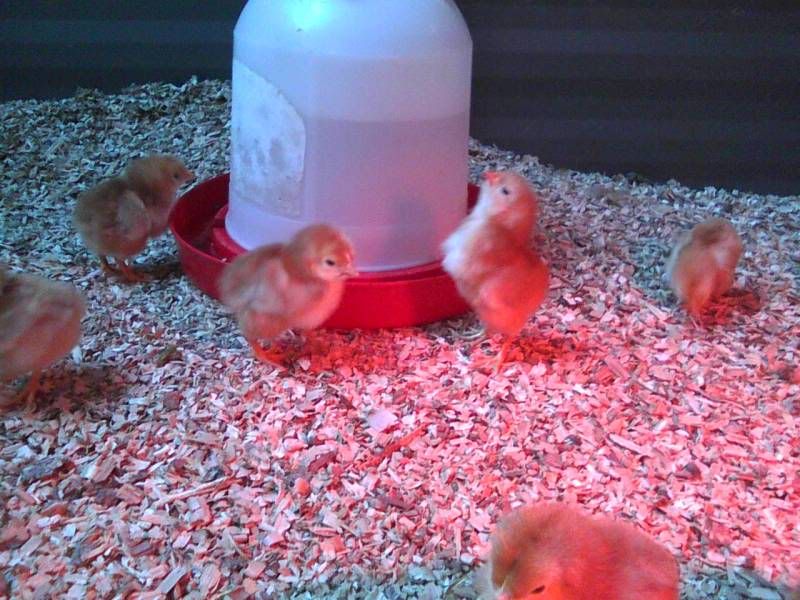
New chicks arrived yesterday and are happily running around in the brooder under the warm lights.  This is a run of laying hens that will be sold once they reach maturity and are ready to start laying eggs.  They are adorable fuzz balls and scurry around like little mice, darting from one place to another.  There are a few curious chicks who have found ways to escape.  Fortunately, I've found them pretty quickly and have been able to get them back under the lights for warmth.

The bunnies are now three weeks old and have all their rabbit fur.  They are leaving the hutch and venturing out into the grass with their mother.  A few have figured out how to reach and use the waterer.  Next week, we'll re-breed Big Bertha and wean the kits.

Three other does are due to have their litters next weekend. It's going to be a very busy weekend!

February 23, 2012

Ingenuity

Ingenuity- word of the day.

Our 200 cockerel chicks quickly outgrew the makeshift trough brooders in the garage but it was still a bit too cold and windy to move them back out to the barn brooding stall.  After all the work getting through that first cold week, we really didn't want to lose any more chicks because we weren't diligent in protecting them from the cold.

We couldn't turn them loose in the barn stall yet because it was still too cold and windy.  The brooder lights alone weren't enough to keep the chicks warm.  We need to insulate them from drafts.  I had previously put up styrofoam insulation panels as draft guards and to provide some heat retention. Great idea until the chicks decided it would be fun to peck at them until they got to the styrofoam, pulled off pieces and then chased each other trying to grab the styrofoam out of each other's beaks.  We considered putting in the wood brooder dividers we used last year but the chicks started jumping pretty high and we were afraid they'd jump out, get cold and be unable to get back into the brooder and the lights.

I was at a loss for what to do but it was clear they couldn't stay in the garage any longer. We already caught a few testing their ability to jump out of the troughs.

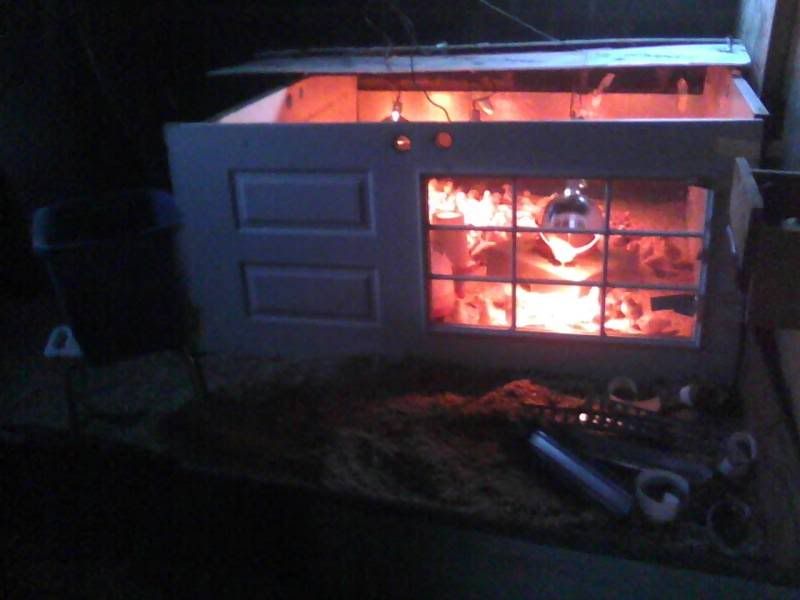
I got to the farm on Tuesday and started hunting around for Greg.  I found him in the brooder stall.  That man is brilliant.  I'll admit I let out a big laugh when I saw his solution, but honestly, it's ingenious!


The back wall is cement with a styrofoam panel, then a piece of aluminum siding nailed to it to keep the chicks from pecking at the insultion.  The other three walls are old doors from a job site that were going to be thrown out.  The roof area is made from the original insulation walls.  I don't know about you, but I LOVE the window door in front!  As soon as we walk up, we can see how the chicks are doing.  Once it warms up enough and the chicks are another week older, we'll take the doors down and they'll have full run of the stall.

It made me laugh but it really is pretty awesome brooder. And it's just redneck enough.

July 10, 2011

Polyface Farm Field Day Photos

Greg and I spent Saturday at Polyface Farm in Staunton, VA for their Farm Field Day.  For one day, they open their farm to the public, and share their trade secrets with anyone willing to pay the admission fee, make the drive and endure the heat.  Fortunately, it wasn't beastly hot!

We arrived around 7:30am. Because of some radical changes in the weather, there was an amazing fog in among the hills and gullies as we drove down some very windy and narrow back-roads to get to the farm.  After registering and checking out the vendors, we did some exploring.  We were able to get a good idea of how the broiler pens were constructed and laid out, how they build their pastured rabbit pens, checked out the rabbitry, hay barns, hoop houses, and egg-mobiles.

We sat in on some small group "workshops" while the morning tour was underway.  Polyface served a fantastic lunch of bbq chicken, sliced fresh peaches and cucumbers, buttermilk chocolate cake as well as beef and pork bbq. It was delish!

After lunch, we participated in the afternoon tour of the farm. We saw their feather-net enclosed laying hens, salad bar beef, pasture fed broiler chickens and turkeys, sows with piglets, pastured hogs, brooder houses and hay barns. With all of this, there was a lot of discussion and information sharing.

I didn't take a lot of pictures but here's the few I did remember to snap while on the tour.  We had a great time on the Polyface farm and are very encouraged about what we can do on the farm.

The 1-mile trek around a small portion of the farm was such an educational experience.

This coop houses 1,000 chickens plus a couple guard-geese and is moved daily.
It sits on 1/4 acre, fenced with electric poultry netting.

A little bit closer look

Joel telling us about the set-up

All of these layers are Barred Rocks. Gorgeous chickens!

Walking to the next site for the tour... but we went the wrong way and had to back track.

Free range turkeys.  In the background are the broiler chicken pens.

Joel standing on a broiler pen talking to everyone.

June 13, 2011

Yes, we're crazy

"Yes, we're crazy."  Yep, that about sums up our weekend.

It was Chickenpalooza at the farm. Seriously. Chickens everywhere!

Let me back up and start at the beginning.

This past winter, Greg and I spent a lot of time discussing what he wants to do with the farm, the direction of his goals, where we should invest our time, energy and money on the farm and how we can accomplish these goals.  We are both in agreement that natural, sustainable, slow-food is our focus. That's a lofty goal and somewhat of an agricultural buzz phrase in recent years. But the truth is that more and more consumers want locally grown food from farms they can trust.  They want to know that their food is wholesome and that they're not serving pesticides to their family while increasing their carbon footprint by importing food from other countries while their own local farms struggle to survive.  We get it and that's what we want too. We want to provide that for our own family and we want to provide it to our local community as a producer.

With all of this in mind, we decided to focus on produce, beef cattle, eggs and broiler chickens.  There were a lot more ideas on our list of goals but not everything could be accomplished this year so we tabled a few items for 2012.

Green egg!
Greg had some Rhode Island Red hens and I bought a baker's dozen of Ameracauna chicks this past November. All together, we had about two dozen chickens on the farm. We kept the two flocks separate and let the Ameracaunas free-range around the farm. It was so exciting when those hens finally started laying! I still get excited every time we have a green egg.  We both especially liked that the chickens were running free all over the place, pecking at bugs and grass and doing their part in the cycle of farm life.

We wanted to expand our flock and kept an eye out for layers to go on sale and eventually found someone selling 17 week old, red sex-link hens through Southern States.  We each ordered 12. We estimated that, based on the number of eggs our current flock was producing, we would be gathering over 30 eggs a day once we added 24 more hens to the farm.  With that amount of production, we could commit to providing regular delivery to weekly customer base - people like us who wanted pesticide free, cage free, hormone free, arsenic free, antibiotic free, all natural, pasture-fed eggs. That's a mouthful, but you get the point. Chickens doing and eating what chickens are supposed to do and eat so they can produce nutritious eggs.

Part of this equation was providing the free range without annoying the neighbors, keeping the hens safe and controlling where they lay their eggs.  This is where the crazy part enters.

I did a lot of research. We had lengthy discussions. We weighed the pros and cons of each free range model.  And of course we ended up with the most unconventional model.  Based on Robert Plamondon's personal experiences, research and instruction, we decided to break away from the traditional chicken coop that included nesting and roosting in one facility.  There are a lot of reasons we felt this would work best for us and I'll discuss those reasons in another post. We could have built a large traditional coop or an egg-mobile. Nope! Greg built a nesting coop and a roosting house - and at the last minute, he also built a feeding station. This two-house system is designed to encourage ranging, discourage egg cannibalism, and stress the field as little as possible while providing the best possible field fertilization.

This weekend, it was time.  It was time for the ... what's the saying? The hens to come home to roost?? Whatever. It was chicken time!

The hens were delivered to Southern States on Saturday and we had to pick them up.  We weren't quite ready and it was a rough weekend with lots of frustration.  We made mistakes - some costly mistakes and some that were easy to remedy. We worked hard - really hard. I mean REALLY hard. There was yelling, there was laughing, there was excitement and disappointment and frustration and exhaustion... and lots of sweating in the sun.

By the end of Saturday, we had 41 new hens out in the field. Did I mention we got more than the 24 we originally ordered? When we got there to pick up our hens, they asked if we wanted more. A gentleman had ordered 24 hens but was sick and unable to get them so they were available for sale.  In the three minutes time it took us to discuss if we wanted more and how many more, more and more of the hens were being sold off to people on the waiting list.  We ended up buying an additional 17 hens.  Again with the crazy.

The one thing I keep coming back to is this -- what if it works? What if we never tried?  What if it doesn't work? Would we try again and do things differently? What did we learn this weekend?

And, hey, what. if. it. works.

I knew going into this that we'd get a lot of criticism. I also knew that not everyone would understand what we are trying to accomplish. I'm not afraid to make mistakes and I'm not afraid to fail. I don't want to look back and say, "Gee, we should have tried..." Neither Greg nor I know how well this will work. But here's what I do know - I know that we're taking a chance and working on our goal of making the farm self-sufficient. We're trying to provide a superior quality product than what you can get in the grocery store.  We have happy hens who will have a happy life. We're working together and learning as we go. 

And we're a little crazy.


May 21, 2011

Good fences

... make for good neighbors but for the farm, good fences keep the deer out.

We lost our entire corn crop last year to deer.  Here's hoping they will stay out this year. Took Mike and me a few weekends to get this done. Couldn't have done it without him, for sure. Time to disc this field and get it planted!


April 6, 2011

Fixing fences

The older calves really need a pasture. They've been penned in the fenced area behind the barn. It's a great area for keeping an eye on the younger calves and makes it easy to keep an eye on their health.  But they've eaten down the grass until there's just about nothing left.  Then need more pasture and the grass needs a chance to grow back.  I've had to hold off putting them in the pasture behind the barn because the fences needed to be fixed. Barbed wire needs to be tightened or added, field fencing needs to be replaced, new fence posts need to be driven and a new gate needs to be put up.

I was able to get some partial rolls of good field fencing at a farm auction and my cousin Mike got us a great deal on fence posts.  Every day after work, we've been working on putting the posts in the ground, tightening barbed wire and putting up the field fencing. If the weather holds out, we should have it done this week. 

This pasture will give the calves about three acres to roam, eat lush, green grass and get into trouble.  I'll be putting Sharon's crazy nesting house and roosting house out there too. It'll be a busy pasture!


July 22, 2010

Working the farm

It was a very busy weekend here on the farm.

Right now, I have three gardens growing.  With the almost complete lack of rain this summer, keeping the gardens watered has been incredibly difficult.  Because of this, my cousin Mike and I jerry-rigged a waterer and tried it out.  We hooked up a small electric pump and pump water out of the creek into a tank, then pump the water out of the tank and onto the gardens.  It takes forever to fill up that 275 gallon tank so I have my eye out for a stronger pump.

The garden is producing green beans, tomatoes, Hungarian and jalapeno peppers, zuccini, yellow and white squash and cucumbers.  A lot of the tomatoes have the blight.  The watermelons and cantelopes seem to be coming along fine despite the dry weather.  However, the carrots and corn aren't fairing as well.

Mike and I spent a good portion of the morning weeding and tieing up tomatoes. After picking hot peppers, we went inside and made a ton of hot dogs and hot peppers.  In the end, we had 13 quarts canned. Not too bad for one day's work!

As far as our experimental commercial type garden which is about an acre or so, after the very little rain we got the hundreds of seeds we planted have started to come up.  This includes watermelons, cucumbers, squash, three types of pumpkins, gourds, cantelopes and sweet corn. Even though the corn is finally growing, the deer are eating it as fast as it comes up.  I don't expect that any will survive until harvest to be sold.  My goal was to prove that I could plant a successful, large-scale garden for commercial sale.  I've definitely proven that I'm capable but need to figure out how to tackle the deer problem and have a more efficient water plan for next year.

Sunday morning and once again we were hauling water from the creek and pumping it on the gardens.  Added Miracle Grow to the two smaller, personal-use gardens.The rest of the day I worked on clearing brush along the one side of my driveway.  I have a long driveway that is about a third of a mile long.  One side is an old fence row that is overgrown with briars, locust, tulip popular, vines and such. I'm tired of driving off to one side to avoid all the limbs.  The big snows we had this past winter laid those limbs across the driveway and made it twice as hard to plow the snow and with them up against the drive made it hard to have room to plow. So far I have hauled five trailer loads of brush and am only a quarter of the way done. But, wow, what a difference! In some places, I have gained four or five extra feet of width for the driveway so need to keep plugging along on it till it is done.

There's always something to do.